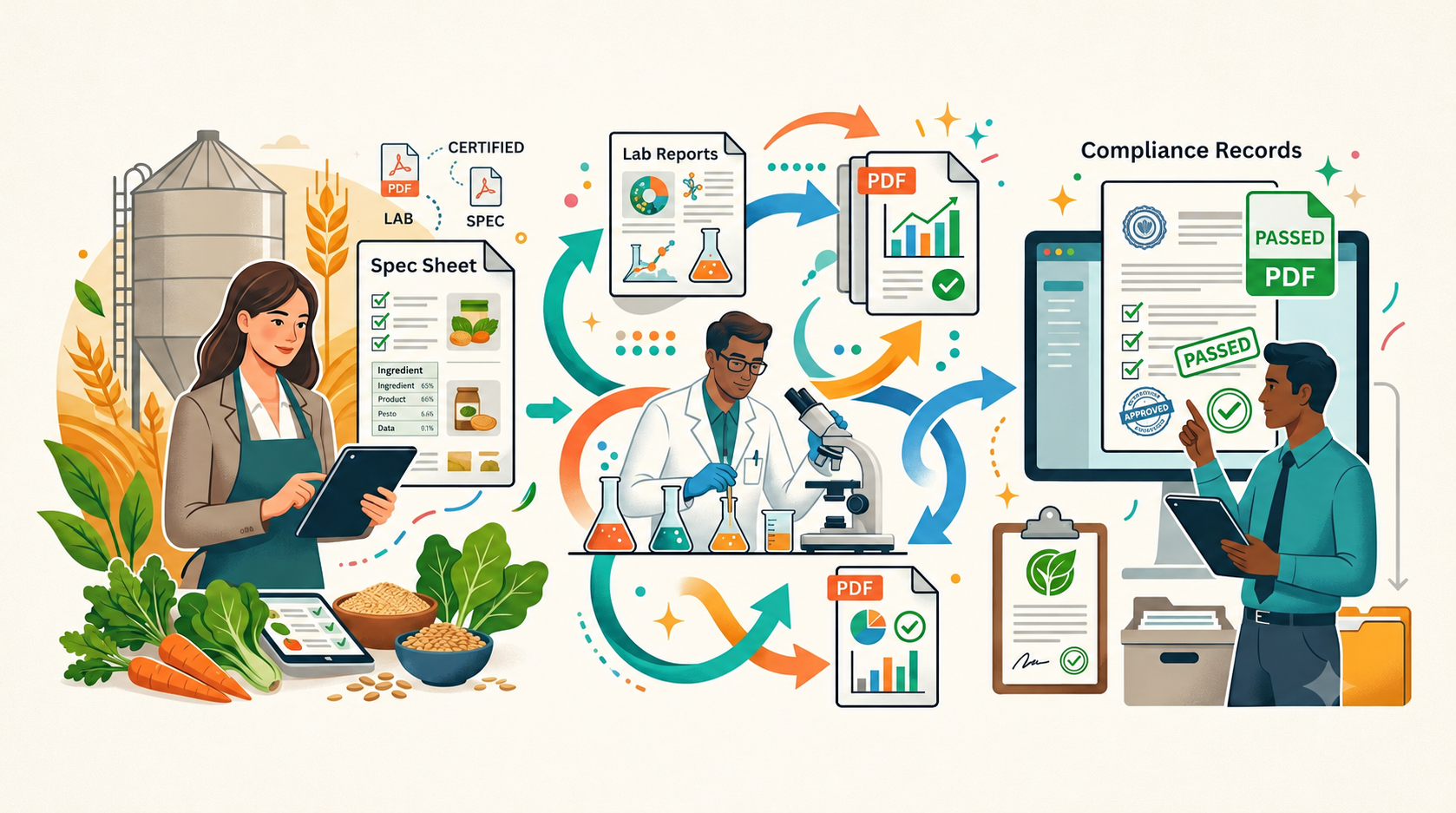
Every packet of biscuits, carton of milk or jar of pickle on a shop shelf has a paper trail behind it. Before that product left the factory, someone had to agree on what it should contain, someone tested it, and someone recorded that each safety step was done correctly. In most food companies today, a large share of that paper trail lives in one file format: the PDF.
I study Food Processing Technology, and subjects like food quality, food safety management and food laws keep coming back to the same idea: if it is not documented, it did not happen. At the same time, I work on PDFs Doctor, a free online PDF tool suite, so I spend a lot of time thinking about how documents are created, shared and stored. This article brings those two sides together.
Below, I explain the three big families of food industry documents (specification sheets, lab reports and compliance records), why PDF became the default format for them, what the regulations actually say about keeping records, and the practical habits that keep a food business's PDFs organised and audit-ready.
Note: This article is for general education. It is not legal or regulatory advice. Food businesses should always confirm requirements with their regulator, certification body or a qualified food safety consultant.
Why food businesses depend on documents
Food safety is preventive. Unlike a broken phone, a contaminated product can make people seriously ill before anyone notices a problem. So food safety systems are built around controlling hazards in advance and proving that the controls worked.
The internationally recognised framework for this is HACCP (Hazard Analysis and Critical Control Point), described in the Codex Alimentarius General Principles of Food Hygiene (CXC 1-1969). HACCP has seven principles, and the last one is specifically about documentation:
- Conduct a hazard analysis and identify control measures.
- Determine the critical control points (CCPs).
- Establish validated critical limits.
- Establish a system to monitor control of CCPs.
- Establish corrective actions for when a CCP is not under control.
- Validate the HACCP plan and establish verification procedures.
- Establish documentation concerning all procedures and records appropriate to these principles and their application.
That seventh principle is why a food plant generates so much paperwork. Every temperature check, every supplier approval and every lab result becomes evidence. And because that evidence has to travel between suppliers, manufacturers, laboratories, auditors and regulators, it needs a format that looks the same everywhere. That is where PDF comes in.
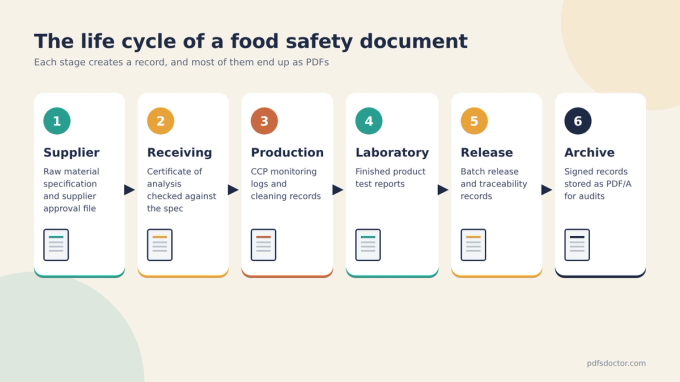
Why PDF became the standard format
Food companies use spreadsheets, ERP software and dedicated quality management systems, but when a document needs to be shared or frozen as a record, it is usually exported or scanned to PDF. There are good reasons for this:
- It looks identical on every device. A specification approved by a buyer in Mumbai should look exactly the same when an auditor opens it in another country. PDF is an open standard (ISO 32000) designed to preserve layout, fonts and images.
- It is hard to change by accident. A Word file or spreadsheet can be edited with one stray keystroke. A PDF acts more like a finished, "issued" version of a document.
- It can hold scanned paper records. Many plants still fill in logs by hand on the production floor. Scanning those sheets into PDF turns them into digital records that can be searched by file name, sorted and backed up.
- It supports signatures. PDFs can carry electronic signatures or signed approval pages, which matters when a quality manager must sign off a specification or a deviation report.
- It has an archiving version. PDF/A (ISO 19005) is a version of PDF built for long-term preservation. It embeds fonts and avoids features that depend on outside resources, so the file should still open correctly years later.
Part 1: Product specification sheets
A product specification sheet (often just called a "spec sheet" or "spec") is the agreed definition of a product. It is the reference document everyone checks against. A food manufacturer will typically hold specifications for:
- Raw materials and ingredients received from suppliers (for example, wheat flour, sugar, milk powder or spices).
- Packaging materials such as films, cartons and labels, including food-contact suitability.
- Finished products that the company sells to retailers, distributors or other manufacturers.
What a good spec sheet contains
Spec sheets vary between companies, but most include these sections:
- Product identification: product name, product code, version number and date of issue.
- Ingredient declaration: ingredients listed in descending order of weight, plus origin information where relevant.
- Allergen information: which allergens are present as ingredients, and which may be present through cross-contact.
- Physical and chemical parameters: for example moisture, pH, water activity, fat or salt content, each with a target and an acceptable range.
- Microbiological limits: acceptable levels for indicator organisms and pathogens, such as total plate count, yeast and mould, E. coli or Salmonella.
- Nutritional information: values per 100 g and per serving.
- Packaging, storage and shelf life: pack format, storage temperature and best-before or use-by period.
- Regulatory and certification status: for example vegetarian status, halal or kosher certification, or organic claims.
- Approval block: names, roles, signatures and dates from both supplier and customer.
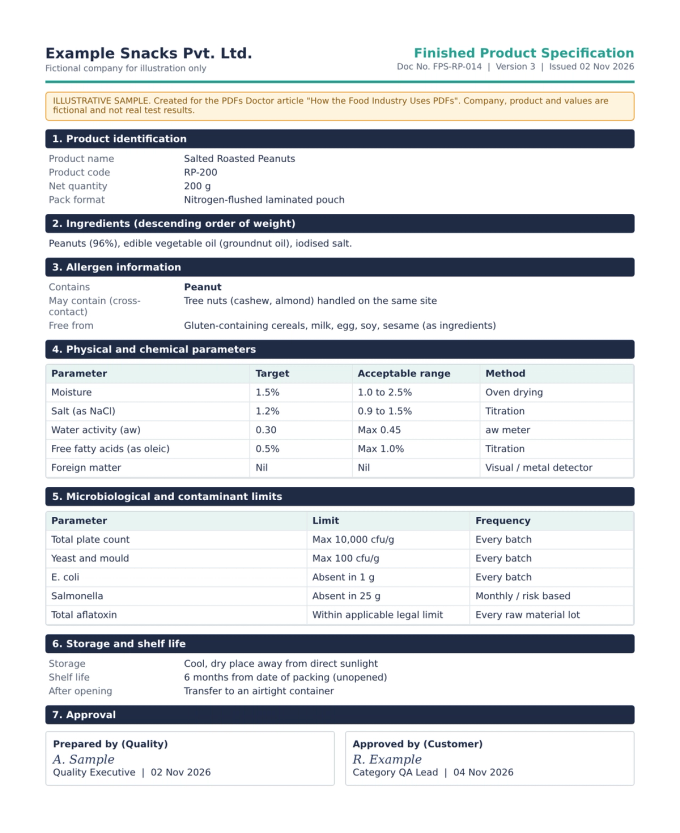
(Example of a one-page finished product specification sheet for a fictional roasted peanut product, showing identification, ingredients, allergens, physical, chemical and microbiological limits, storage and an approval block. Illustrative sample created for this article. The company and product are fictional.)
Why allergen data on spec sheets matters so much
Allergen information is one of the most sensitive parts of any specification, because an error can flow straight onto a consumer label. Different markets regulate different allergens. In the European Union, Regulation (EU) No 1169/2011 lists 14 allergens that must be emphasised on labels. In the United States, sesame became the ninth major food allergen on January 1, 2023, under the FASTER Act. In India, the FSSAI Labelling and Display Regulations, 2020 set out allergen declaration requirements for packaged food.
This is why food companies treat spec sheets as controlled documents. When a supplier changes a recipe, the new specification needs a new version number, and the old PDF must be clearly marked as superseded so nobody uses outdated allergen data.
Part 2: Laboratory reports and certificates of analysis
If the spec sheet says what a product should be, the lab report shows what it actually is. Food businesses deal with two main kinds of lab documents.
Certificates of analysis (CoA)
A certificate of analysis is a document, usually issued by the supplier, that reports test results for a specific batch or lot. A typical CoA includes:
- Supplier and product details, including product name and code.
- Batch or lot number, along with production and expiry dates.
- Each parameter tested, such as moisture, aflatoxin, or microbiological counts.
- The specification limit for each parameter.
- The actual result for that batch.
- The test method used, often referenced to a standard method.
- A pass or fail conclusion, with the name and signature of the person who released it.
When goods arrive at a factory, the receiving or quality team checks the CoA against the agreed specification before accepting the batch. If a result is outside the limit, the batch can be put on hold or rejected.
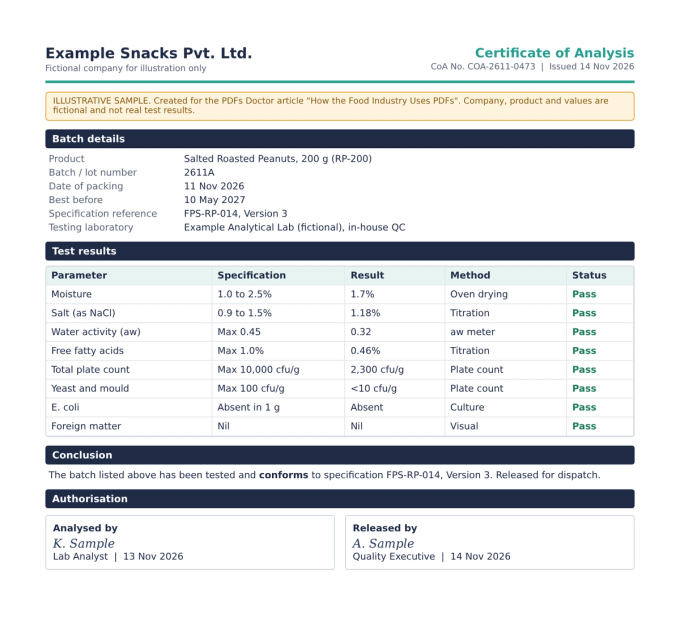
(Example certificate of analysis for a fictional batch of roasted peanuts, comparing each test parameter with its specification limit and showing a pass result. Illustrative sample created for this article. The laboratory, company and results are fictional.)
Third-party laboratory test reports
Many tests are sent to independent laboratories, especially for pathogens, pesticide residues, heavy metals, mycotoxins and nutritional labelling. Their reports almost always arrive as PDFs.
A useful thing to check on these reports is accreditation. Testing laboratories are commonly accredited to ISO/IEC 17025, the international standard for the competence of testing and calibration laboratories. In India, laboratories are accredited against this standard by NABL (National Accreditation Board for Testing and Calibration Laboratories). An accredited report usually shows the accreditation body's mark and the lab's certificate number, which gives the result more weight in an audit.
Turning lab PDFs into useful data
One weakness of PDF lab reports is that the numbers are "locked" inside the document. A quality team that wants to see whether moisture levels in a raw material are slowly drifting upward over six months has to pull values out of dozens of CoAs.
Converting the reports with a tool such as PDF to Excel or PDF to CSV can make this trend analysis much faster. One important habit: always cross-check converted figures against the original PDF before you rely on them, especially for results close to a limit. The PDF stays the official record; the spreadsheet is only a working copy.
Part 3: Compliance and food safety records
The third family of documents proves that the food safety system is actually running every day. These are the records auditors and inspectors spend most of their time reading.
Common types of compliance records
- HACCP or food safety plan: the hazard analysis, CCPs, critical limits and procedures.
- CCP monitoring logs: for example cooking temperatures, metal detector checks, pasteurisation time and temperature.
- Corrective action reports: what went wrong, what was done with the affected product, and how the cause was fixed.
- Prerequisite programme records: cleaning and sanitation, pest control, water testing, personal hygiene and staff training.
- Calibration records: proof that thermometers, scales and other instruments read correctly.
- Supplier approval files: supplier questionnaires, certificates, audit reports and agreed specifications.
- Traceability and recall records: which raw material lots went into which finished product lots, and where those products were shipped.
- Audit and certification documents: reports and certificates from schemes such as BRCGS, SQF or FSSC 22000, which are benchmarked by the Global Food Safety Initiative (GFSI).
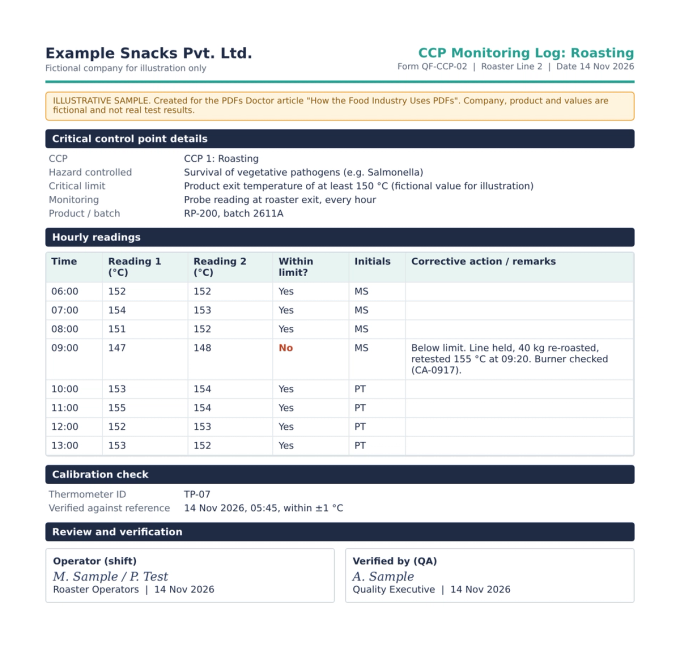
(Example critical control point monitoring log for a fictional roasting line, with time, temperature readings, critical limit, initials and a corrective action note. Illustrative sample created for this article. The company and readings are fictional.)
What the rules say about keeping records
Record-keeping rules differ by country, so here are a few well-known examples rather than a complete list:
- United States, Preventive Controls for Human Food (21 CFR Part 117): records required under this rule must be retained for at least 2 years after the date they were prepared. Records can be stored offsite if they can be retrieved and provided onsite within 24 hours of a request, but the food safety plan itself must remain onsite. Electronic records kept to meet Part 117 are exempt from the separate 21 CFR Part 11 electronic records rule.
- United States, Food Traceability Rule (FSMA Section 204): firms handling foods on FDA's Food Traceability List must keep Key Data Elements for Critical Tracking Events and provide records to FDA within 24 hours of a request. During an outbreak or recall, FDA can ask for an electronic sortable spreadsheet. The original compliance date was January 20, 2026, but Congress directed FDA not to enforce the rule before July 20, 2028, and FDA has proposed moving the compliance date to that day.
- European Union, General Food Law (Regulation (EC) No 178/2002, Article 18): food businesses must be able to identify who supplied them and to whom they supplied products, often described as "one step back, one step forward" traceability.
- India, Food Safety and Standards Act, 2006: licensed food businesses are expected to follow the hygiene and sanitary practices set out in the FSSAI licensing and registration regulations, and to maintain records that show those practices are being followed.
One detail stood out to me while researching the US traceability rule: the format FDA asks for during an outbreak is a sortable spreadsheet, not a PDF. That is a good reminder that PDFs are excellent for preserving records, but structured data (like a spreadsheet or database) is better when records need to be searched and sorted fast. Strong food businesses use both.
How food teams can manage PDFs well
Knowing which documents to keep is only half the job. The other half is keeping them findable, readable and trustworthy. Here are practical habits that make a real difference during an audit.
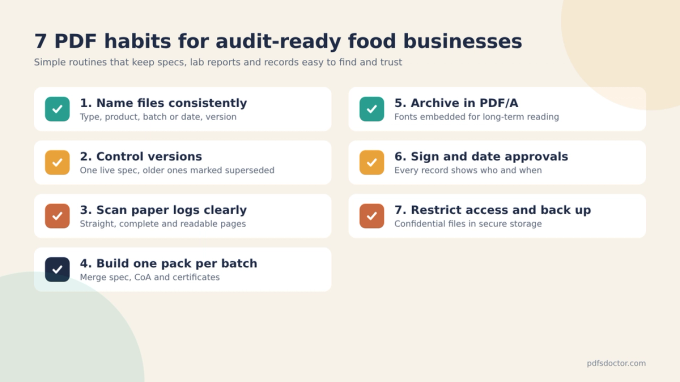
1.Use a consistent file naming pattern
A clear pattern lets anyone find a record in seconds. A simple example is: document type, product or line, batch or date, and version. For instance, "CoA_RoastedPeanuts_Lot2611A_v1.pdf" or "CCPLog_RoasterLine2_2026-11-14.pdf". Using the year-month-day date format means files sort in date order automatically.
2.Control versions of specifications
Keep only one current version of each specification in your "live" folder. Move older versions to a clearly named archive folder, and mark them as superseded. This prevents someone from checking a delivery against an outdated allergen list.
3.Digitise paper logs carefully
Production floor records are often handwritten. Scan or photograph them at a readable resolution and combine the images into a single PDF per shift, day or batch using a tool like JPG to PDF. Check that every page is straight, complete and legible before filing it. If pages come out sideways, Rotate PDF fixes that in a few seconds.
4.Build one complete file per supplier or batch
Auditors often ask for everything related to a single supplier or a single batch. Instead of sending ten separate attachments, use Merge PDF to combine the specification, CoA, certificates and approval form into one organised pack. When you need to send only part of a large file, Split PDF lets you extract just the relevant pages.
5.Archive long-term records in PDF/A
Some records need to stay readable for years, especially for products with long shelf lives. Converting final records with PDF to PDF/A helps ensure they will still open correctly in the future, because fonts are embedded and features that rely on external content are not allowed.
6.Sign approvals in a traceable way
Specifications, deviation reports and corrective actions usually need a named person to approve them. For routine internal approvals, Fill and Sign PDF lets a manager add a signature and date without printing. For systems that fall under stricter electronic signature rules, such as FDA's 21 CFR Part 11 where it applies, a validated electronic records system is normally required, so check your own regulatory obligations first.
7.Protect confidential documents
Recipes, supplier pricing and audit findings are commercially sensitive. Share them only with people who need them, avoid forwarding them through personal accounts, and keep copies in a secure, backed-up location. If a file becomes corrupted or will not open, a tool such as Repair PDF can sometimes recover it, but a proper backup is always the safer plan.
Common mistakes to avoid
From what I have learned in my coursework and from reading guidance published by regulators, these are some of the most common documentation problems in food businesses:
- Accepting a CoA without checking it. A CoA is only useful if someone compares it against the specification and confirms that the batch number matches the delivery.
- Keeping several "final" versions. Files named "spec_final", "spec_final2" and "spec_final_NEW" create confusion during audits.
- Unreadable scans. A blurred photo of a temperature log does not prove the check was done.
- Missing signatures or dates. Records without a name and date are weak evidence.
- Records scattered across personal inboxes. If only one person knows where a file is, the business is at risk when that person is unavailable.
- Treating converted data as the official record. Spreadsheets made from PDFs are helpful working copies, but the original signed PDF should remain the reference.
Frequently asked questions
Are PDFs accepted as official food safety records?
In many cases, yes. Regulators and certification bodies generally accept electronic records, including PDFs, as long as they are accurate, complete, legible and can be produced when requested. For example, FDA's Part 117 rule explicitly allows electronic records. However, the exact requirements depend on your country, your products and your certification scheme.
What is the difference between a specification and a certificate of analysis?
A specification defines what a product should be, including its limits and acceptable ranges. A certificate of analysis reports the actual test results for one particular batch. You compare the CoA against the specification to decide whether the batch is acceptable.
How long should food businesses keep records?
It depends on the regulation. Under the US Preventive Controls for Human Food rule, records must be kept for at least 2 years. Other countries, schemes and customers may require different periods, and many companies keep records for at least the shelf life of the product plus an additional margin. Always confirm the period that applies to your business.
Why use PDF/A instead of a normal PDF for archiving?
PDF/A is a version of PDF designed for long-term preservation. It requires fonts to be embedded and does not allow features that depend on outside content, so the document should display the same way many years later.
Can I edit a supplier's CoA if I spot a mistake?
No. A CoA is the supplier's or laboratory's record. If you find an error, ask the issuer to send a corrected and re-signed version. Changing someone else's certificate yourself would undermine its value as evidence.
Final thoughts
When people think about food safety, they usually picture clean equipment, hairnets and laboratory tests. Those things matter, but documentation is what connects them all. A specification sets the target, a lab report proves the result, and a compliance record shows the controls worked on a specific day for a specific batch.
PDFs became the backbone of this system because they are reliable, shareable and stable over time. Used with good habits like clear naming, version control, careful scanning and proper archiving, they turn a pile of paperwork into a clear, auditable story of how safe food was made.
References
- Codex Alimentarius Commission. General Principles of Food Hygiene (CXC 1-1969). FAO/WHO. https://www.fao.org/fao-who-codexalimentarius/
- U.S. Food and Drug Administration. 21 CFR Part 117: Current Good Manufacturing Practice, Hazard Analysis, and Risk-Based Preventive Controls for Human Food, Subpart F (Requirements Applying to Records). https://www.ecfr.gov/current/title-21/chapter-I/subchapter-B/part-117
- U.S. Food and Drug Administration. FSMA Final Rule on Requirements for Additional Traceability Records for Certain Foods. https://www.fda.gov/food/food-safety-modernization-act-fsma/fsma-final-rule-requirements-additional-traceability-records-certain-foods
- Federal Register. Requirements for Additional Traceability Records for Certain Foods: Compliance Date Extension (August 7, 2025). https://www.federalregister.gov/documents/2025/08/07/2025-14967/requirements-for-additional-traceability-records-for-certain-foods-compliance-date-extension
- U.S. Food and Drug Administration. Food Allergies: What You Need to Know (sesame as the ninth major allergen). https://www.fda.gov/food/buy-store-serve-safe-food/food-allergies-what-you-need-know
- European Union. Regulation (EC) No 178/2002 (General Food Law). https://eur-lex.europa.eu/eli/reg/2002/178/oj
- European Union. Regulation (EU) No 1169/2011 on the provision of food information to consumers. https://eur-lex.europa.eu/eli/reg/2011/1169/oj
- Food Safety and Standards Authority of India. Food Safety and Standards Act, 2006 and regulations. https://www.fssai.gov.in/
- National Accreditation Board for Testing and Calibration Laboratories (NABL). https://nabl-india.org/
- International Organization for Standardization. ISO 19005 (PDF/A) and ISO 32000 (PDF). https://www.iso.org/
Disclaimer: This article is intended for educational purposes only and does not constitute legal, regulatory or professional food safety advice. Regulations change over time, so always refer to the latest official guidance from your regulator or certification body.